

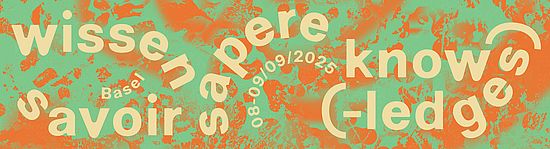
2025 | SAGS International conference "wissen – savoir – sapere – know(-ledges)"
The 8th conference of the Swiss Association for Gender Studies (SAGS) took place at the University of Basel on September 8/9, 2025. It invited contributions from the field of gender studies around the conference theme "wissen – savoir – sapere – know(-ledges)".
In 1927, Virginia Woolf stands in the reading room of the British Museum. She finds no knowledge produced by women. Pondering the reasons for these “blank spaces”, Woolf problematizes the way in which (academic) knowledge is produced and hierarchies are created between different forms of knowledge. Further, women are denied the resources and spaces they need to creatively produce knowledge, as Gertrude Bustill Mossell had already noted 33 years earlier. Gender studies research and teaching in its various forms and formats across the globe have inherited and continued these projects of uncovering and filling the gendered, sexualized, classicist and racialized gaps in available knowledges as well as creating ‘room’ for thought and alternative modes of knowledge production. This always requires the critical, self-reflective examination of one’s own knowledge practices and positionalities.
Key questions for gender studies as a heterogeneous, multi- and interdisciplinary endeavor, thus, are: Who (and what) participates and can participate in knowledge production? How is knowledge authorized or discredited? In what ways are knowledges about gender and sex entangled with power dynamics? And not least, what ways of knowing and knowledges are needed for 'better worlds' to become realities?
Against the backdrop of pressing current issues – climate changes, artificial intelligence, anti-democratic and authoritarian seizures of power, wars and persistent global and domestic inequalities – the 8th conference of the Swiss Association of Gender Studies invited participants to address these – and other – questions together at the University of Basel to promote the gender studies community and connect Swiss and international researchers from all career levels in academia and related fields of expertise.
Six thematic strands offered an entry point to foster exchange among gender studies scholars from various disciplines and fields of research.
1 Revisiting feminist theories and gender studies
Which concepts, analytical terms and theoretical interventions have prevailed so far, which have fallen into oblivion and/or should be revitalized? Which are missing and which come with troubling and troublesome heritages? Which dialogues between the different theoretical, thematic and activist strands of feminist theory and gender studies are currently flourishing, which are in conflict or at an impasse? What are the (hierarchical) relations between different analytical tools and approaches? What roles do the materialities of gender and sex, as well as dialogue with the natural and biomedical sciences, play in all of this?
2 Applying gender studies
What forms and methods of applying gender studies have proven productive in different situations and contexts? How can the teaching of gender studies critically address the numerous challenges of inclusion in knowledge production, including the inclusion of more-than-humans? How can gender studies be translated for diversity and gender equality work? How can gender studies be related to and articulated through different media and for different publics? What challenges arise in the relation between academic and (non-academic) practice-based knowledges?
3 Circulations of gender/ed knowledge(s)
What knowledge about gender, sex/ualities and bodies have been and are produced, taken up, and spread by whom and in which contexts – from politics, to economics, education, law, medicine and cultural institutions? Which knowledges have been and continue to be dismantled or not distributed in the first place? How are these different bodies of knowledge entangled with power relations, and what role do different technologies and media play in their constitution, mediation and circulation?
4 Knowledge politics, blank spaces and epistemic injustices
What does critique of existing knowledges and dominant modes of knowledge production look like and what can it achieve? What do epistemic responsibility and justice mean and how can they be realized within gender studies and beyond? How are feminist and queer knowledges complicit in epistemic injustices? Which questions are not, or else too little addressed within gender studies? What issues constitute blank spaces in existing bodies of knowledge? Under what conditions, and in which different socio-material and political situations, is participation in the production or sharing of knowledge(s) im/possible? What spaces and forms of articulation are available or must yet be invented? How to deal with what is not or cannot be known? How is gender (non-)knowledge mobilized to consolidate hierarchies and exclusions, to strengthen authoritarian positions and exploitative structures and relations?
5 Knowing gender in the past tense
How can gender’s past be listened to and recognized? How do past, forgotten conceptions and practices of gender, gender roles, sex acts and sexuality challenge or inform knowledge and knowledge production today? What other forms of (gendered) knowledge and knowledge production can be uncovered in past epistemes? How could gender’s plural histories be made productive for the ongoing development of concepts and knowledge practices?
6 Utopias, speculations and re-visions
What did emancipatory proposals for multiplying existences and creating ‘better worlds’ look like in the past? What form do or could they take today? What is needed to imagine and bring these worlds about? And, what part does knowledge (production) play in these processes? Which bonds of kinships, alliances and solidarity need to be woven and how? How does speculative knowledge become practice?
Date | Venue
September 8/9, 2025
University of Basel, Kollegienhaus
Conference Team
Bianca Prietl (University of Basel)
Marion Schulze (University of Basel)
Nathalie Amstutz (FHNW, Olten)
Aden Kumler (Basel)
Student Support
Wanja Gerber | Marisa Rigas | Selina Schönholzer
Scientific Advisory Board
Angela Berlis (University of Bern) | Stefanie Boulila (Lucerne University of Applied Sciences and Arts) | Ilana Eloit (University of Geneva) | Dominique Grisard (Vice president of SAGS, Basel) | Anna Leyrer (University of Basel) | Clovis Maillet (University of Applied Sciences and Arts of Western Switzerland) | Chus Martinez (University of Applied Sciences Northwestern Switzerland) | Patricia Purtschert (University of Bern) | Brigitte Röder (University of Basel) | Jasmin Schmidlin (University of Basel) | Sigrid Schmitz (Humboldt University of Berlin) | Franziska Schutzbach (Verein Feministische Wissenschaft Schweiz, Basel)
Quick Links
Social Media