


Graduate Research Programme I
Science – Gender – Symbolic Order
During the first phase of the Graduate Research Programme in Gender Studies, from 2002 to 2005, the Basel programme focused on deepening participants’ theoretical foundations (particularly in gender theories) and methodological knowledge. This exploration was framed by a focus on the three fields of analysis that gave the programme its name.
Here, ‘science’ refers to all aspects relating to knowledge within a society. It encompasses both forms and content of knowledge and categories of thought, as well as science as a social institution or way of life. It also addresses questions concerning different bodies of knowledge and cultures of knowledge and research in the humanities, social sciences and natural sciences. As science emerges and develops within specific social contexts, gender relations and knowledge of gender play a role in the production and transmission of knowledge.
The concept of symbolic order is linked to the assumption that a symbolic order exists in every society. It is, as it were, the grammar of meaning and significance attributed to things within a society. The symbolic order encompasses not only certain ideas or concepts, but also social institutions, social mechanisms, prevailing bodily practices, emotions and everyday ways of life.
Gender and gender relations are not understood as a given of nature, but primarily as a social phenomenon – in short, as a ‘social construct’. From this perspective, science and the symbolic order become ‘spaces’ in which the respective gender order or the respective notions of gender, of ‘femininity’ and ‘masculinity’, are constructed, reproduced and, possibly, also transformed.
Gender and gender relations are not understood as a given of nature, but primarily as a social phenomenon – in short, as a ‘social construct’. From this perspective, science and the symbolic order become ‘spaces’ in which the respective gender order or the respective notions of gender, of ‘femininity’ and ‘masculinity’, are constructed, reproduced and, possibly, also transformed.
Events
2002
| Gender Talks/Gender Matters
International conference to mark the launch of Research Training Group I, University of Geneva, Keynote: Anne Fausto-Sterling (Brown University, Rhode Island), “Sex and gender: shifting boundaries within a unified body”
2003
| Gender Methodologies in Different Disciplines
Summer School I, University of Basel, Keynote: Elisabeth Bronfen (University of Zurich), “The Power of Beauty. Mae West, Pin-ups and Chuck Palahniuk”
2004
| Conceptualisations of Gender
Summer School II, University of Zurich, Keynote: Hilge Landweer (Free University of Berlin)
2005
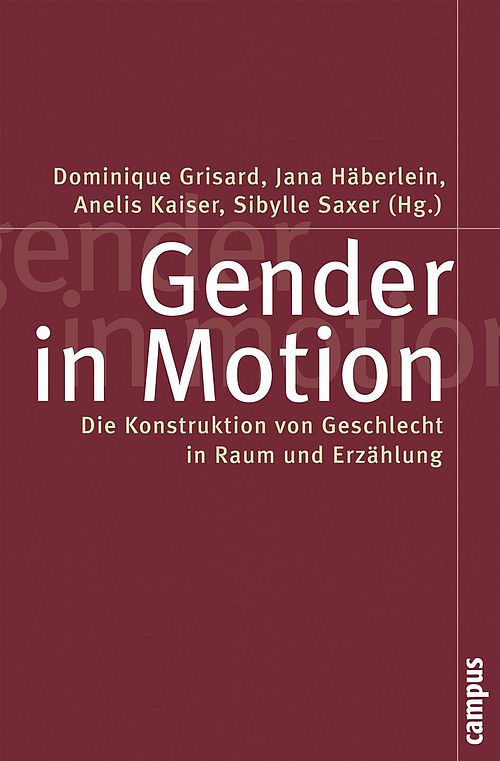
| Gender in Motion. New Perspectives in Gender Studies
Final conference of Research Training Group I, University of Basel, Keynote: Nancy Fraser (The New School, New York City), “Gender in Motion”
2002-2005
Managing Director
Andrea Maihofer
Coordination
Dominique Grisard
Graduate School Faculty
Ursula Ackermann-Liebrich | Social and Preventive Medicine
Susanna Burghartz | History
Dieter Buergin | Child and Adolescent Psychiatry
Annelies Häcki Buhofer | German Linguistics
Sabine Maasen | Sociology of Science
Ueli Maeder | Sociology
Andrea Maihofer | Gender Studies, Philosophy, Sociology
Cordula Nitsch | Anatomy
Claudia Opitz | History
Fabienne Peter | Economics
Ingeborg Schwenzer | Private Law
Regina Wecker | Women’s and Gender History
Elisabeth Zemp | Social and Preventive Medicine
Quick Links
Social Media